01 / Understand
The financing decision
How do covered, enclosed and outdoor spaces contribute to collected rent and funding needs?
Build the revenue case from spaces that can actually accept the intended vehicles. Record each space’s dimensions, enclosure, clearance, access and contract status, then reconcile billed fees with collections. Boat and RV storage should not be confused with campground accommodation, marina operations or a vehicle-repair business merely because the customers use similar equipment.
Separate the storage products
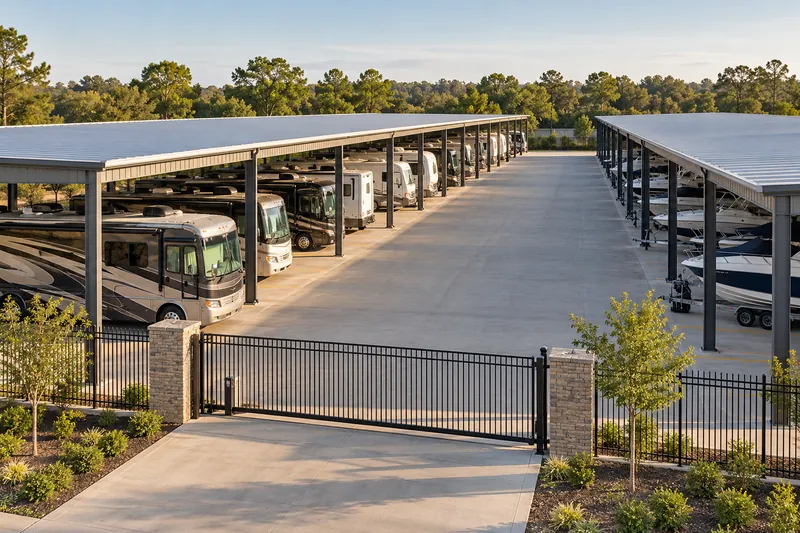
Extra Space Storage distinguishes indoor, covered and outdoor boat storage in its own offering. Use that practical distinction to organize your inventory, while obtaining local evidence for this property’s rates and demand. The operator’s national marketing prices are not rent comparables.
Sources: Extra Space Storage — Boat Storage
Review activities beyond storage
EPA’s industrial stormwater overview identifies maintenance, cleaning and material handling as activities relevant to its coverage framework. Determine whether they occur at this site and ask the appropriate authority or specialist about applicability. Pure storage and a repair operation need separate factual descriptions.
Sources: EPA — Stormwater Discharges from Industrial Activities
Treat capacity changes as a project
Before adding covered stalls, reconcile the design to circulation, setbacks, drainage, utilities and approvals. Keep estimated new rent separate until supported. A nominal increase in stall count may also remove maneuvering area or require capital that the existing operating model does not include.
A hypothetical decision
Hypothetical: converting outdoor spaces to covered storage
An owner expects higher monthly fees after installing canopies over part of the yard.
Compare supported new fees with lost operating spaces during work, revised vehicle clearances, permitting time and cash construction costs. Preserve the existing-space case until the plan is validated.
The takeaway: A higher price per covered stall is useful only after reconciling rentable capacity, construction cash and actual collection demand.
Dedicated to boat and rv storage facilities
Download your niche underwriting package.
Use this dedicated Excel workbook with its lender guide and document checklist. Read the workbook instructions, replace illustrative assumptions with your evidence, and keep the guide beside your analysis.
Model scope and limitations
Enclosed, covered and outdoor spaces are disjoint inventories with separate prices and paying fractions. Never place the same physical stall in two categories. Fractional paying spaces are monthly economic averages.
Paying fractions already reflect vacancy, nonpayment and concessions. Enter effective rent and paying fractions consistently so a discount is deducted once. Seasonality follows the monthly entries, not a national seasonal assumption.
- All numerical values are illustrative; no market facts or lender approval are asserted.
- The twelve-month operating model omits taxes on investor returns and future refinancing costs except expressly entered items.
- Legal, licensing, environmental, engineering and lender-specific recognition require actual diligence.
Excel .xlsx · PDF .pdf · No email required. Preparation materials do not constitute a loan offer or a lender’s document requirements.
Package reviewed by Jason Taken ·
Next: gather your lender documents ↓Related core asset model
Compare the existing core workbook.
The scope below describes the related core asset workbook. The dedicated niche package above has its own instructions and limitations.
The existing Self-storage underwriting model offers a collection and operating-cash framework.
Model scope and additional analysis
It is not a vehicle-dimension, site-layout, canopy-engineering, campground or marina model.
Prepare an additional schedule: Add a space-type and dimensional-capacity schedule with seasonal occupancy and separately funded site improvements.
Test property-level loan sizing · Check post-closing liquidity
Questions to prepare for a lender
Use these questions to organize a financing discussion. A lender sets its own credit requirements and determines which evidence applies to your transaction.
Which spaces produce paid recurring revenue?
Prepare a space-level schedule of type, size, customer contract, promotional fees, arrears and collected rent over comparable seasonal periods.
Does the layout work for the advertised vehicles?
Provide a measured plan and qualified assessment of gates, turning, clearance and access; distinguish legal capacity from marketing capacity.
What activities and services are actually sold?
Separate storage from maintenance, washing, launching, hookups or accommodation, and identify the applicable approvals and operating costs.
03 / Prepare
Build your document checklist.
Check off what you have. Your selections stay on this page while it is open; they are not sent to Jaken Finance Group or analytics.
0 of 5 document groups marked ready
Print uses your browser’s PDF option. Checklist selections are for your preparation, not a lender’s completeness determination.
Continue the learning path.
Self-storage economic occupancy and loan sizing
Reconcile occupied units, contracted rent and collected revenue before using self-storage cash flow to size commercial debt.
Industrial outdoor storage: legal use and lender collateral
Reconcile surveyed area, documented use rights and leased storage area before presenting industrial outdoor-storage income and collateral to lenders.
Sources and applicability
The references support the specific points identified above. Preparation questions, checklists and hypothetical decisions are the publication’s analysis, not instructions issued by the source or a lender.
- Extra Space Storage — Boat StorageTypes of Storage for Boats; Common Boat Storage Sizes · Checked 2026-10-21
Primary operator description of product types; rates and promotional claims are not used as underwriting evidence.
- EPA — Stormwater Discharges from Industrial ActivitiesIndustrial Stormwater Overview; regulated categories; Authorized States · Checked 2026-10-21
Applicability depends on activities, discharge and permitting authority; a storage label does not determine coverage.
AI-assisted research and preparation. Published by Jaken Finance Group. Reviewed by Jason Taken on 2026-10-21. Report a correction.